
 05/19/2026
 BUILDLAB
 6 min read
Revenue-Generating WiFi: How Property-Wide Internet Becomes a Standalone Income Line
Bulk WiFi, owner-owned fiber, ISP revenue share — a working breakdown of how multifamily owners are turning broadband into a $30–50 per door per month income stream.
For most of the last decade, in-building internet was a cost center: pay an ISP, charge residents whatever the market would bear, hope the help desk did not get called. In 2026, sophisticated multifamily owners treat it as a standalone income line. The category goes by several names — Enter-Net-Income, Revenue-Generating WiFi, Owner-Owned Fiber — but the underlying math is the same.
The three operating models
- Carrier-managed: an ISP installs and operates the network. Owner gets door fees and possibly profit share, but the equipment, billing, and resident relationship belong to the ISP.
- Bulk WiFi: the owner buys connectivity wholesale and includes it in rent or a mandatory fee. Margin lives between the wholesale cost and what residents are effectively paying.
- Owner-owned fiber-backed WiFi: the owner owns the in-building network end to end. Property-wide WiFi is the amenity; an ISP relationship handles upstream transport. Margin is widest, control is highest, infrastructure cost is real.
Each model has a place. The right answer depends on unit count, hold horizon, capital availability, and the operator’s appetite for running a small ISP inside their building.
What the math actually looks like
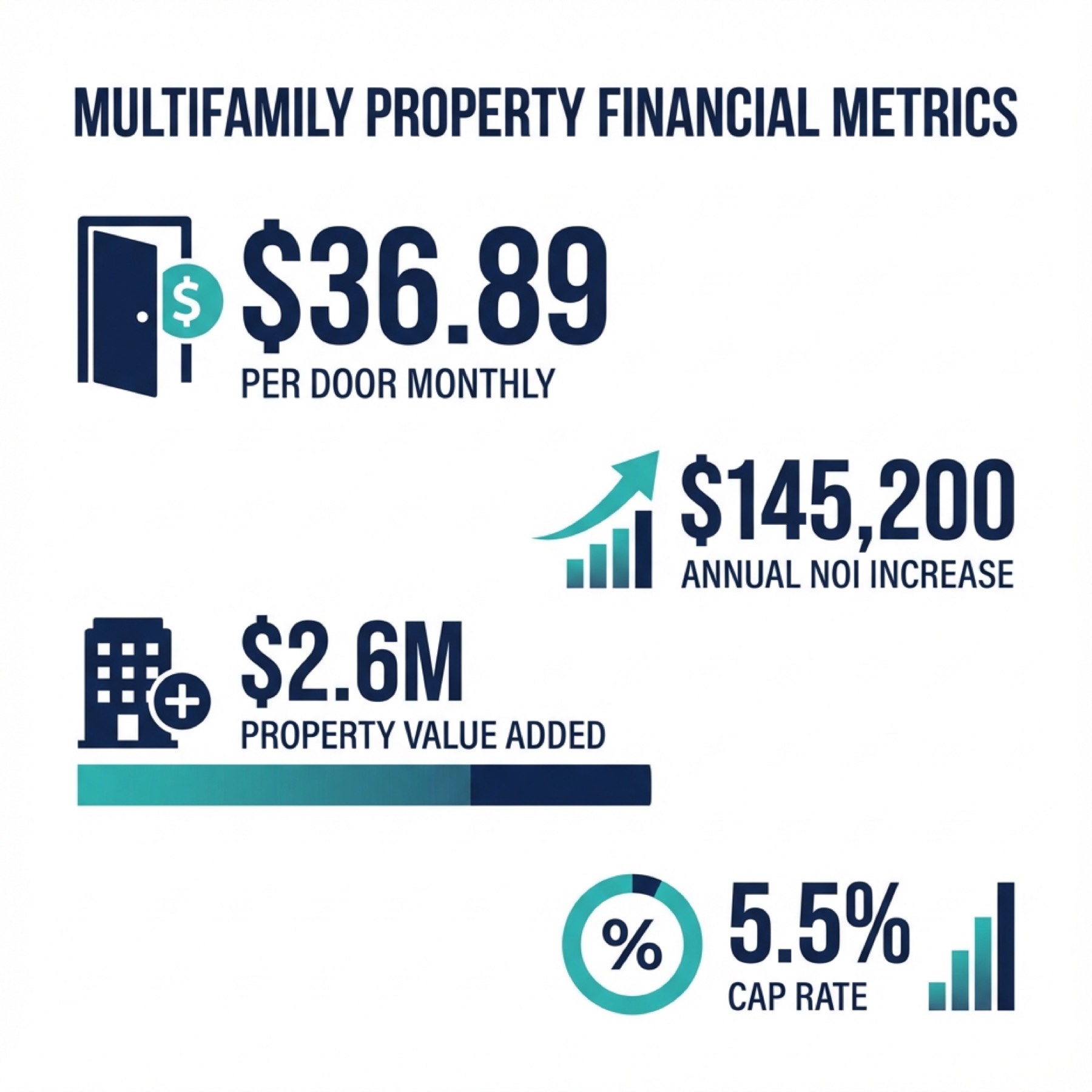
Across the institutional operators publishing case studies, fiber-backed property-wide WiFi consistently generates $30–50 per door per month in net ancillary revenue once a building is stabilized. A 200-unit building at the midpoint produces roughly $96,000/year of NOI lift — which on a 5.5% cap rate is north of $1.7M in value at exit.
For affordable housing operators, the math is more constrained. Rent restrictions limit how much can be folded into a mandatory fee, but the ISP door fees, profit-share, and CASF infrastructure grant offsets are still very real. BUILDLAB has secured $194K+ in door fees and 7–8% ongoing profit share across recent affordable housing projects without changing what residents pay.
The infrastructure decisions that decide the outcome
The model only pencils if the in-building network was designed for it. The decisions made during pre-construction — fiber path, MDF location, IDF count, conduit sizing, AP density — set the ceiling on how much revenue this scope can ever generate. Retrofits to a building that was wired for a 2010-era ISP cost multiples of what it would have cost to do it right at construction.